
A delayed or cancelled flight with SAS gives the right to compensation under EU Regulation 261/2004 — EUR 250, 400 or 600 (roughly SEK 2,800, 4,500 or 6,800) depending on how long the flight was. The condition is that the delay was at least three hours to the final destination and that the cause was within SAS's control. SAS is Scandinavia's largest airline, but that grants no exemption from the regulation. This page goes through how SAS's claim process works in practice, where to turn, and what to do when SAS says no — which happens more often than it should. Read more in the pillar page on flight delays and compensation . Kravflyg keeps this guide aligned with the primary sources and current case law.
How much compensation an SAS flight is worth
EU 261 splits flights into three distance tiers by length. The SAS network spans everything from short domestic hops to intercontinental routes, so all three levels are relevant:
| Flight distance | Compensation | Roughly in SEK | Typical SAS route |
|---|---|---|---|
| Up to 1,500 km | EUR 250 | ≈ SEK 2,800 | Stockholm–Gothenburg, Stockholm–Copenhagen, Stockholm–Oslo |
| 1,500–3,500 km | EUR 400 | ≈ SEK 4,500 | Stockholm–London, Stockholm–Rome, Stockholm–Málaga |
| Over 3,500 km | EUR 600 | ≈ SEK 6,800 | Stockholm–New York, Copenhagen–Tokyo |
The euro amount is the legally binding one — it is the sum SAS must pay. The SEK amount is approximate and moves with the exchange rate. What counts is the delay on arrival at the final destination, not how late the plane left the gate. If you want to see what your journey is worth, you can work out your flight compensation based on distance and delay length.
If you get a no from SAS, the claim can be escalated to ARN.

EU 261 applies to SAS domestic flights too
A common misconception is that purely Swedish domestic flights would fall outside an EU regulation. They do not. EU 261 applies to all departures from an airport within the EU, and a departure from Bromma, Arlanda, Landvetter or Malmö is exactly that. The SAS route Stockholm–Umeå is covered just as fully as Stockholm–Paris. On a short domestic route the amount is EUR 250.
Compensation is not a refund
When SAS cancels a flight, two rights are easily confused, and SAS's own communication does not always help to keep them apart. Compensation is the flat-rate amount of EUR 250–600 for the disruption itself. A refund is the money back for a ticket you no longer intend to use. Read more in the basics of EU 261 .
If a flight is cancelled, you have the right to choose between re-routing to the next available departure and a refund of the ticket — and on top of that you may be entitled to compensation. The fact that SAS refunds the ticket price, or offers a voucher, does not close the compensation question. Do not accept a voucher as a "solution" to the compensation claim unless you expressly want to. The distinction is set out more closely in our overview of passenger rights under EU 261.
SAS's claim process — how to submit the claim
SAS handles EU 261 claims via its own customer service. The process in practice:
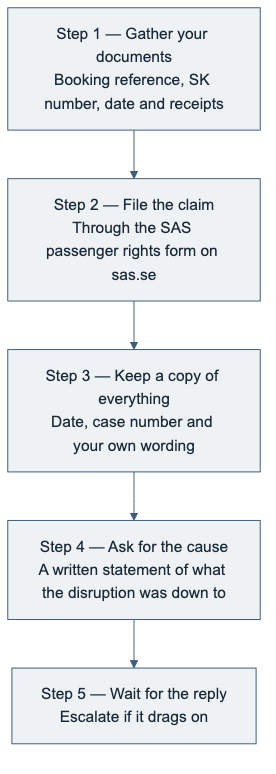
- Gather the documentation. Booking reference, flight number (the SK number), date, the airports, and receipts for expenses during the wait — food, transport, hotel.
- Submit the claim via SAS's passenger rights form. It is reached via sas.se and in the SAS app under customer service/feedback. Write explicitly that you are requesting compensation under EU Regulation 261/2004, state the length of the arrival delay and the amount you believe you are entitled to.
- Keep a copy of everything. The date, the case number and your own wording. This becomes your documentation if the case has to be escalated.
- Request a written statement of the cause. Ask SAS to state what the disruption was caused by. You will need it if the airline later cites an extraordinary circumstance.
- Wait for the reply — but not indefinitely. If it drags on for months, that in itself is a reason to take the matter further.
The whole process, including how to phrase a claim that is hard to dismiss, is in the guide on claiming flight compensation yourself.
SAS and the habit of saying no first
Here is the honest part. Experiences that Swedish and Nordic travellers share in forums point in a clear direction: airlines often reject a compensation claim in their first response, and only pay once the passenger stands their ground. One traveller who pursued a claim against a Nordic airline described how it took more than two and a half months and many emails, "including references to EU legislation," before the compensation came — after an initial no.
SAS is no exception to that pattern. It does not mean SAS acts in bad faith every time, but it does mean that a first no should not be taken as a final decision. The most common objections are that the delay was under three hours (check the arrival time, not the departure time) or that the disruption was an extraordinary circumstance. The latter is worth scrutinising — a technical fault that is part of normal maintenance is generally not counted as extraordinary, even if the airline phrases it that way. What actually applies is set out on the page about extraordinary circumstances.
How to escalate if SAS does not budge
If you get a no, a low counter-offer or just silence, there is a free route forward:
- Allmänna reklamationsnämnden / ARN (the Swedish National Board for Consumer Disputes) examines the dispute at no cost to you. ARN issues a recommendation that most airlines in practice follow.
- Transportstyrelsen (the Swedish Transport Agency) is the supervisory authority for air passenger rights in Sweden and can provide guidance.
- A court is the last step, rarely necessary for individual EU 261 claims but possible.
You can also hand the whole case over to a claim service — more on that trade-off further down.
An SAS strike — a question of its own
Strikes at SAS repeatedly attract major attention, and the legal position there is not the obvious one you might assume. The short version: a strike by SAS's own staff — pilots, cabin crew — is generally counted as something within the airline's control and gives the right to compensation. A strike by air traffic controllers or airport staff is beyond SAS's control and is treated as extraordinary.
Because this is a subject in itself — and because demand swings sharply during an ongoing strike — we have a separate overview. If you are stuck in a strike disruption with SAS, see SAS strikes and compensation rather than relying on the short version here.
SAS, Braathens and the carrier relationship
SAS cooperates with other players on the Swedish domestic network, and Braathens Regional (BRA), a Swedish domestic carrier, is a recurring point in that coverage. For you as a passenger it is simple: the claim is always directed at the operating carrier — the airline whose flight number you actually flew on. If the ticket said SK, SAS is the counterparty. If you flew BRA, our page on BRA and Braathens flight compensation applies instead. Read more in compensation for BRA flights .
This is not legal advice
This page is based on EU Regulation 261/2004 and institutional sources. It is general information, not an assessment of your individual case — expert review has not yet been carried out. For advice on your specific case, contact Allmänna reklamationsnämnden / ARN (the Swedish National Board for Consumer Disputes) or Transportstyrelsen (the Swedish Transport Agency), the supervisory authority for air passenger rights in Sweden.
The five-step process for an SAS compensation claim, from documentation to escalation.
Pursue the claim yourself — or hand it over
Claiming compensation from SAS is free if you do it yourself according to the steps above. It takes patience, especially if SAS says no first, but you keep the full amount. The guide on claiming flight compensation yourself takes you all the way.
If you would rather skip the fight itself, a claim service can handle the contact, the paperwork and any dispute for a commission on the compensation paid out.
<div class="seomatrix-info-box">
<p>You can let AirHelp check your SAS flight and pursue the claim for you: <a href="/go/airhelp" rel="nofollow sponsored noopener">check your flight with AirHelp</a>. The service works on commission — you only pay if the claim goes through — and you can always pursue the case free of charge yourself instead.</p>
</div>
<p class="seomatrix-disclaimer">Disclosure: the link to AirHelp above is an advertising link. If you proceed via it, Kravflyg may receive compensation, at no extra cost to you and with no effect on your commission rate. We explain how this works on the <a href="/en/affiliate-disclosure/">affiliate disclosure</a> page.</p>
Frequently asked questions
How much compensation can I get for a delayed SAS flight?
The amount is EUR 250, 400 or 600 (roughly SEK 2,800, 4,500 or 6,800) depending on flight distance. A SAS journey within Scandinavia normally gives EUR 250; Stockholm to, say, London or Rome gives EUR 400; an intercontinental SAS route over 3,500 km gives EUR 600. The delay must be at least three hours to the final destination.
How do I claim compensation from SAS?
You submit the claim via SAS customer service, normally through the passenger rights form on sas.se or in the SAS app. State the booking reference, flight number, date and an explicit reference to EU 261/2004. Keep a copy of the claim. If you get a no or no reply, you can take the matter further free of charge to ARN, the Swedish National Board for Consumer Disputes.
SAS said no to my compensation — what do I do now?
A no in the first response is common and should not be taken as a final decision. Ask SAS to state the cause of the disruption in writing, challenge it if it looks doubtful, and escalate to ARN, the Swedish National Board for Consumer Disputes, which examines the dispute free of charge. ARN's recommendation is in practice followed by most airlines.
Am I entitled to compensation if SAS cancelled the flight due to a strike?
It depends on who was striking. A strike by SAS's own staff — pilots or cabin crew — is generally counted as something within the airline's control and gives the right to compensation. A strike by air traffic controllers or airport staff is beyond SAS's control and counts as extraordinary. The details are on our page about SAS strikes and compensation.
Does EU 261 apply to SAS domestic flights in Sweden?
Yes. EU 261/2004 applies to all flights departing from an airport within the EU, including purely Swedish domestic routes such as Stockholm–Gothenburg or Stockholm–Malmö. SAS domestic flights are fully covered. A short domestic flight gives the EUR 250 compensation level.
Does my EuroBonus membership affect the right to compensation?
No. The right to EU 261 compensation is independent of whether you are a EuroBonus member and of which ticket class you bought. It follows from the regulation, not from the loyalty programme. Points or a voucher that SAS offers do not replace the cash compensation either, unless you expressly accept that.
Sources and further reading
- EUR-Lex — Regulation (EC) No 261/2004
- Court of Justice of the EU — Sturgeon and Others, joined cases C-402/07 and C-432/07 (the three-hour rule); Krüsemann and Others, C-195/17 (a strike by an airline's own staff)
- Transportstyrelsen — Passenger rights (the supervisory authority in Sweden)
- Konsumentverket — Delayed and cancelled flights (the Swedish Consumer Agency)
- Allmänna reklamationsnämnden / ARN — the Swedish National Board for Consumer Disputes, which examines disputes free of charge for the consumer
Last reviewed: 17 May 2026.


No comments yet