
You can claim compensation for a delayed, cancelled or overbooked flight entirely on your own, and the whole official route is free. You need no representative and no service — the right under EU 261/2004 is the same regardless of who submits the claim. This page is not about whether you are entitled to money, but about how you actually collect it: where you turn, in what order, what you write, and what you do when the airline says no, stays silent, or tries to buy its way out with too low a sum. Kravflyg keeps this guide aligned with the primary sources and current case law.
If you first want to know whether you are entitled to compensation at all, start with flight delay compensation or cancelled flight compensation. This page takes over from there: you know you have a claim and you want to pursue it.
The process in brief
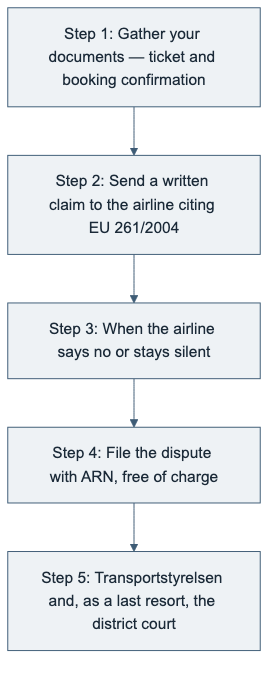
The route has four stages, and you rarely need to go the whole distance:
- Claim to the airline. You send a written claim directly to the airline. Most cases begin and end here.
- ARN — the Swedish National Board for Consumer Disputes. If the airline says no or does not reply, you file the dispute with ARN (Allmänna reklamationsnämnden), which reviews it free of charge.
- The Swedish Transport Agency. Transportstyrelsen is the supervisory authority for air passenger rights in Sweden — a parallel route and a channel for applying pressure.
- Court. As a last resort, you pursue the claim as a simplified small-claims case at the district court.
It costs you nothing until the possible final step, and even there the fee is low. The only thing you stake is time.
The way forward when the airline refuses or stays silent on your claim.

Step 1 — Gather your documents
Before you write anything, gather the evidence. A claim that is easy to check is a claim that is hard to dismiss.
- Booking confirmation and ticket number.
- Boarding pass, if you still have it.
- Times: the scheduled departure and arrival, and the actual arrival time at the final destination. It is the arrival delay that counts, not the departure delay.
- All written communication from the airline — texts, emails, messages at the gate.
- Receipts, if you also want to claim back extra costs such as meals or a hotel. A Reddit user who claimed on their own sums it up: "If you're claiming for a missed hotel night or lost income, you need proof you had the costs. Keep the receipts."
Note the flight distance — it decides whether the amount is €250, €400 or €600 (about SEK 2,800, 4,500 or 6,800). If you want it exact, calculate your flight compensation first so you have a figure to claim.
Step 2 — Send a written claim to the airline
Send the claim in writing, through the airline's passenger-rights form or by email. In writing, so that you have a timestamp and a trail. Be brief, factual and concrete: state the flight, what happened, the amount you are claiming and the rule you are relying on. Read more in calculate your flight compensation .
Here is a structure you can start from and fill in:
Subject: Claim for compensation under EU Regulation 261/2004 — flight [flight number], [date]
Hello,
I was booked on flight [number] on [date] from [departure point] to [destination], booking reference [reference]. The flight [was delayed / was cancelled / I was denied boarding], and I arrived at my final destination [number] hours later than scheduled.
Under Article 7 of EU Regulation 261/2004, I am entitled to compensation of €[250/400/600] for a flight distance of [distance] km. I request that the amount be paid to [account/IBAN] within 14 days.
Attachments: booking confirmation, boarding pass.
Kind regards, [name]
Quoting Article 7 back at the airline signals that you know the rules. Travellers in forum threads describe it as having to "push them a little" — and this is pushing factually. Set a reply deadline (14 days is reasonable) so that silence becomes a measurable breach you can point to later.
Step 3 — When the airline says no, stays silent or offers too little
This is the stage where most people lose heart, so it deserves to be said plainly: resistance is normal, and it usually does not mean you are wrong.
The airline says no. A first refusal is routine. Self-claimers in forums describe how they "got a no several times" before it broke loose. Ask for a written justification of the refusal. If it says "extraordinary circumstances" — compare it with what actually counts as one; weather and a strike may, but a technical fault and overbooking rarely do. Send a short, factual reply that addresses that specific justification. Do not give up on a standard no.
The airline stays silent. Long silence is a method. It is not unusual to wait more than 2.5 months without an answer. Send a reminder, refer to your original deadline, and state that you will otherwise go on to ARN. Set a new, short deadline.
The airline offers too little. A common move is to offer a voucher or a sum clearly below the statutory amount — passengers describe attempts to "cut the compensation by 50%". A voucher is not cash. Compare the offer with €250/€400/€600 for your distance. If it is lower, you decline in writing and refer to Article 7. You lose nothing by declining a low offer — the right to the full amount stands.
Throughout: keep it in writing, factual and patient. You do not need to get angry, you just need to not stop.
How long you have — deadlines to keep an eye on
A claim does not become invalid because the airline drags things out, but it does if you wait too long. An EU 261 claim is a debt, and debts become time-barred. In Sweden the general limitation period is ten years, but several airlines and courts in other EU countries apply shorter deadlines, and practice has varied between countries. So do not lean on a ten-year limit as a certainty — pursue the claim while it is fresh.
The practical advice is simple: start within a month or a few months of the disruption. Then you still have the receipts, your memory is fresh, and the airline's own documentation of the flight is easy to obtain. If you wait several years, the evidence position gets worse even if the claim itself is still alive. Keep in mind too that ARN has its own deadline for how late after the purchase a complaint will be accepted — it is shorter than the limitation period, so do not let the case sit.
Step 4 — File with ARN
If you cannot get any further with the airline, the next step is ARN, the Swedish National Board for Consumer Disputes. ARN is a state authority that reviews consumer disputes at no cost to you. You fill in a complaint at arn.se, describe the dispute and attach your documents and the airline's reply.
ARN's decision is a recommendation, not a court ruling — but most reputable airlines follow them, and a decision in your favour is a strong document if the case should go further still. Expect a review to take several months. Two practical things to know: ARN normally does not review cases below a certain minimum amount, and there is a deadline for how long after the purchase you can file — check the current terms at arn.se before you submit.
A complaint to ARN is not "going to battle" in the exhausting sense either. You fill in a form, attach your documents and the airline's reply, and ARN then handles the correspondence. The airline gets a chance to respond, you get to read the response, and the board decides on the documents. You do not need to appear anywhere. The case landing with ARN also puts a certain pressure on the airline — an airline that knows it is in the wrong sometimes chooses to pay once the complaint is in, rather than getting a documented decision against it.
Step 5 — The Swedish Transport Agency and, as a last resort, court
The Swedish Transport Agency (Transportstyrelsen) is the supervisory authority for air passenger rights in Sweden. It does not decide your individual dispute the way ARN does, but it handles complaints against airlines and is a channel worth using in parallel — both to get guidance and as pressure.
Court is the last step. An EU 261 claim can be pursued in the district court, and because the amounts usually fall below half a price base amount (a Swedish statutory reference figure), they are handled as simplified small-claims cases. That means a low application fee and a limited cost risk — you normally do not risk being forced to pay the other party's full legal costs. You do not need a representative for a simplified small-claims case, but it is the most time-consuming step. Most cases never need to come this far.
Claiming yourself or using a service — the honest trade-off
Everything above you can do yourself, for free. It is the first-choice route, and it works. But it would be dishonest to pretend it is free in a wider sense: it costs time, patience and a certain amount of stamina to stand up to a no and to silence for months.
That is why passenger-rights services such as AirHelp and Flightright exist. They take over the whole process — claim, escalation, court if needed — and you do nothing. The price is a commission: typically 25–35 percent of the compensation is deducted if they succeed. If you get €400, perhaps €260–300 lands with you. If they do not succeed, it usually costs nothing. Read more in the walkthrough of DIY versus a service .
It is a trade-off between money and hassle, not between right and wrong:
| Claim yourself | Use a service | |
|---|---|---|
| Cost | Free (a low fee only at court) | A commission, typically 25–35% of the compensation |
| You receive | The whole amount — €250 / €400 / €600 | The amount minus the commission |
| Your effort | You pursue the claim, write, wait out the no and the silence | Almost none — the service handles everything |
| Suits | Clear cases, you have time and patience | Awkward cases, hard resistance, you lack the energy |
| Risk | Only your time | Usually no fee if they do not succeed |
- Claim yourself if the claim is straightforward, you have the time, and you want the whole amount. Most clear cases belong here.
- Consider a service if the airline has already stonewalled you hard, if the case is awkward or heading for court, or if you simply do not have the energy and would rather get 70 percent of something than 100 percent of a drawn-out fight.
That a service charges is nothing to be surprised by — the commission is the price for skipping the work. If you want to hand a case over yourself, you can <a href="/go/airhelp" rel="nofollow sponsored noopener">start an assessment with AirHelp</a>. This is an affiliate link: if you use it, kravflyg.com may receive a commission from AirHelp, without affecting your compensation or what the service costs you. More on that on our affiliate disclosure page.
If you want to weigh the options against each other in more detail — commissions, pros and cons, when one beats the other — we have a separate walkthrough: claim yourself or use a service. And if you need to refresh the basics, there is an overview in EU 261 passenger rights.
claim flight compensation
This is not legal advice
This page is based on published and institutional sources — expert review has not yet been carried out. For advice on your individual case, turn to ARN (Allmänna reklamationsnämnden — the Swedish National Board for Consumer Disputes) or Transportstyrelsen (the Swedish Transport Agency), which is the supervisory authority for air passenger rights in Sweden.
Frequently asked questions
Can I really claim flight compensation myself — for free?
Yes. The whole official route is free of charge: the claim to the airline, the complaint to ARN and contact with the Swedish Transport Agency cost nothing. A simplified small-claims case in the district court has a low application fee and limited cost risk. You do not need a representative to pursue an EU 261 claim — the right is the same regardless of who submits it.
The airline said no — what do I do now?
A first no is common and does not mean the claim is over. Ask for a written justification, compare it with what EU 261/2004 actually says, and send a short reply. If the airline holds firm, file the dispute with ARN, which settles it for free. Many people only win at that stage — the airline saying no first says nothing about the merits.
How long does it take to claim compensation yourself?
Expect weeks to months. A clear claim the airline approves can be settled in a few weeks. If the airline drags things out — several months of waiting is common — and the case goes on to ARN, a review there typically takes several more months. It is tiresome, but it costs you nothing other than time.
The airline offered a lower sum than I am entitled to — should I accept it?
Not without doing the maths. A common move is to offer a voucher or a sum clearly below the statutory amount and hope you settle. Compare the offer with €250, €400 or €600 for your flight distance. If it is lower, you can say no and refer to EU 261/2004 — you do not lose the right to the full amount by declining a low offer.
When is it worth using a service instead of claiming yourself?
Claiming yourself is free and it works — it is the first-choice route. A service like AirHelp can be a reasonable alternative if the airline has already stonewalled you, if you lack the energy or time to pursue the case, or if it is heading for court. The price is a commission of 25–35 percent of the compensation — you get less, but you skip the work. It is a trade-off between money and hassle, not between right and wrong.
Sources and further reading
- EUR-Lex — Regulation (EC) No 261/2004 , in particular Article 7 (compensation)
- ARN — Allmänna reklamationsnämnden (the Swedish National Board for Consumer Disputes) — reviews consumer disputes free of charge; see current terms for the minimum amount and deadline
- Transportstyrelsen — Passenger rights (the Swedish Transport Agency, supervisory authority in Sweden)
- Konsumentverket — Air passenger: your rights (the Swedish Consumer Agency)
- Sveriges Domstolar (the Swedish courts) — information on simplified small-claims cases at the district court
Last reviewed: 17 May 2026.


No comments yet