
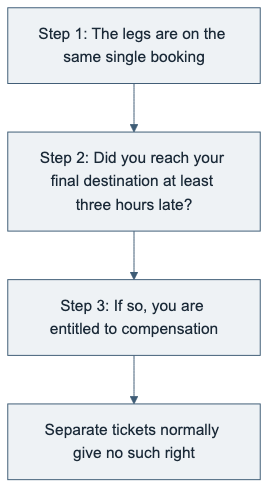
With a missed connecting flight, the right to compensation comes down to two things, and only two: whether the legs were on one and the same booking, and how many hours late you ultimately reached your final destination. If both are met — the same booking and at least three hours' delay at the final destination — you are entitled to compensation of €250 to €600 (about SEK 2,800 to 6,800). If it was separate tickets instead, each flight is assessed on its own, and then the picture looks different. This page works through that two-test rule and where the lines fall. Kravflyg explains, step by step, what to do in this situation.
The two-test rule — the two questions that decide everything
The simplest way to know where you stand is to ask two questions in order.
Question 1: Were the flights on the same booking? If you bought the whole journey in one and the same booking — one booking reference, one ticket covering all the legs — the journey must, under the case law of the EU Court of Justice, be treated as a single connected whole. It then makes no difference that the individual leg that ran late was itself short. The Court of Justice has established this in several cases, including Wegener (C-537/17): a booking with a connection is one journey.
Question 2: How late did you reach the final destination? It is the arrival at your final destination that is measured — not the departure delay, not how late an intermediate leg was. If you arrived three hours or more late at the final destination shown on the booking, the delay test is met.
If the answer to both questions is yes, you normally have a compensation claim. If either one fails, you need to read on — that is where the misunderstandings sit.
missed connection compensation
The most common edge case: "one flight was delayed but I still arrived"
A recurring question in forum threads runs roughly: "Am I entitled to compensation if one of the flights was delayed but I still arrived on time?" The short answer is no — and that is not an injustice, it is the whole logic of the rule. Read more in the walkthrough of cancelled flights .
EU 261 does not compensate the delay in itself. It compensates you arriving late. If your first flight was an hour late but the margin to the connection was still enough, or you were re-routed onto a next flight that got you to the final destination within three hours of the original time — then you have not suffered the delay the law compensates. A late leg that still ends in an on-time arrival gives no claim. We cover what a flight delay can be worth in a section of its own.
Turn it around and the same logic applies: if you miss the connection so that you arrive five hours late, it makes no difference that the first flight was only "a little" late. It is the five hours at the final destination that count, not the twenty minutes at the layover.
Single booking or separate tickets — the line you need to know about
This is the difference most people do not know about, and it can decide whether you have a claim or not.
| Single booking | Separate tickets | |
|---|---|---|
| What it is | All legs in one booking, one reference | Each flight bought on its own, often with different airlines |
| How the journey is assessed | As a single connected whole | Each flight assessed in isolation |
| On a missed connection | A claim against the airline whose flight caused the miss | Normally no claim if each flight kept its own schedule |
| Where the delay is measured | At the final destination | Per individual flight |
If you buy a journey Stockholm–Frankfurt–Singapore as one booking, the airline bears responsibility for the chain holding together. If Stockholm–Frankfurt runs so late that you miss Frankfurt–Singapore, that is a single connected journey that became heavily delayed, and you have a claim.
If you instead buy Stockholm–Frankfurt with one airline and Frankfurt–Singapore with another, as two free-standing tickets, no such link exists. If the first flight was twenty minutes late and you missed the second, the second airline has done nothing wrong — its flight departed on time — and the first airline has only caused twenty minutes of delay, not three hours. You are then in practice left without an EU 261 claim, even though the travel day was ruined. That is the hard line, and it is worth thinking about already at the booking stage: a single booking is not just more convenient, it gives a legal protection that two separate tickets do not.
How much — and which airline
The amount follows the same ladder as a delay and a cancelled flight: €250, €400 or €600 depending on flight distance. For a connecting journey, the distance is calculated on the whole journey — from the first departure point to the final destination — not per leg. A long intercontinental journey therefore normally lands at €600 (about SEK 6,800) even if each individual stage is shorter.
The claim is directed at the operating airline — with a single booking involving several airlines, at the one whose flight caused you to miss the connection. How you then pursue the claim, and what you do if the airline says no, we work through on the page about claiming flight compensation yourself. If you are unsure whether your situation gives a right to money at all, start with am I entitled to flight compensation, or read the broader walkthrough of flight delay compensation. To see the exact amount for your distance, you can calculate your flight compensation.
This is not legal advice
This page is based on published and institutional sources — expert review has not yet been carried out. For advice on your individual case, turn to ARN (Allmänna reklamationsnämnden — the Swedish National Board for Consumer Disputes) or Transportstyrelsen (the Swedish Transport Agency), which is the supervisory authority for air passenger rights in Sweden.
Frequently asked questions
Am I entitled to compensation if one flight was delayed but I still arrived on time?
What matters is not that one leg was delayed, but how late you ultimately reached your final destination. If you arrived less than three hours late — because the margin between the flights was generous, or because you were re-routed onto an early next flight — there is normally no right to compensation, even if one of the flights was itself late. It is the arrival delay at the final destination that counts.
Does it matter whether I booked the flights separately or in one booking?
Yes, it is often the whole difference. If the legs were on one and the same booking, the journey is assessed as a single connected whole, and the delay is measured at the final destination. If you booked the flights separately with different airlines, each flight is assessed on its own — and if you miss the connection because the first flight was a little late, you normally have no claim against the second airline, which kept its schedule.
Which airline do I direct the claim at after a missed connection?
With a single booking, the claim is directed at the airline that operated the flight — the operating air carrier responsible for the journey. If it is a single booking with several airlines, the claim is in practice directed at the airline whose flight caused the miss. With separate tickets, any claim is directed at the airline whose flight was actually delayed or cancelled.
How much compensation can a missed connecting flight give?
The same ladder as with other EU 261 disruptions: €250 (about SEK 2,800), €400 (about SEK 4,500) or €600 (about SEK 6,800) depending on the whole journey's flight distance — measured from the first departure point to the final destination, not per leg. EUR is the legal unit; the SEK figures are approximate.
Do the rules apply even if the connection took place outside the EU?
EU 261/2004 applies to flights departing from an airport within the EU, regardless of airline, and to flights into the EU with an EU-based airline. If your whole single-booking journey is such a journey, it is covered even if the layover itself is outside the EU. What matters is where the journey begins and which airline operates it, not where the connection takes place.
Sources and further reading
- EUR-Lex — Regulation (EC) No 261/2004
- Court of Justice of the EU — Wegener, case C-537/17 (a connecting journey on a single booking is assessed as one connected journey)
- Transportstyrelsen — Passenger rights (the Swedish Transport Agency, supervisory authority in Sweden)
- Konsumentverket — Air passenger: your rights (the Swedish Consumer Agency)
- ARN — Allmänna reklamationsnämnden (the Swedish National Board for Consumer Disputes) — settles disputes at no cost to the consumer
Last reviewed: 17 May 2026.



No comments yet