
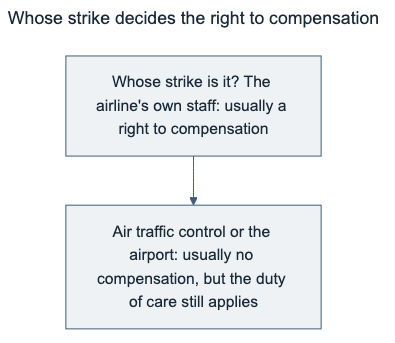
In a flight strike, the right to compensation comes down to a single question: who is striking? If the airline ’s own staff — cabin crew or pilots — strike, the disruption normally counts as something within the airline’s control, and you are then usually entitled to €250–600 (about SEK 2,800–6,800) in compensation under EU 261. If instead air traffic control or airport staff strike, it usually counts as an extraordinary circumstance, and then no compensation is paid — but the right to meals, drinks and a hotel still remains. The Kravflyg editorial team checks every figure and deadline against the source.
This is the point where the most passengers get misled. "A strike means no compensation" is a common belief, and airlines rarely mind it living on. But it is not true. This page goes through the whole picture — which strike pays out, which one does not, what the airline may and may not blame, and what you do next.
Compensation is not a refund — keep the two apart
Before we go further, one thing has to be crystal clear, because it is this area’s most common misunderstanding. Compensation is a fixed flat-rate amount — €250 to €600 — that you receive for the inconvenience itself of a cancelled flight or a long delay. A refund is something else: it is getting the money for your ticket back when you choose not to travel at all. Read more in compensation in a SAS strike .
In a strike you always have the right to choose between rebooking onto a new departure and a refund of the ticket — that applies regardless of who strikes and regardless of whether the strike is an extraordinary circumstance or not. The right to compensation is an entirely separate question. So the fact that an airline offers you your ticket money back does not mean the €250–600 is off the table. The two things are decided separately.
Whose strike it is decides everything: the airline’s own staff versus air traffic control or the airport.

The decisive question: whose strike is it?
EU 261 gives no compensation when a disruption is caused by extraordinary circumstances outside the airline’s control. The whole strike question is about where that line falls. And it falls between the airline’s own people and everyone else.
| Who is striking | Within the airline’s control? | Right to compensation (€250–600) | Right to meals/hotel |
|---|---|---|---|
| The airline’s own cabin crew | Yes, normally | Yes, usually | Yes |
| The airline’s own pilots | Yes, normally | Yes, usually | Yes |
| Air traffic control (ATC strike) | No | No, usually not | Yes |
| Airport staff (ground, security, baggage) | No | No, usually not | Yes |
| Staff at a subcontractor | Assessed case by case | Unclear — depends on the circumstances | Yes |
The logic behind the table is simpler than it looks. When the airline’s own staff strike, the dispute is about the airline’s own employment terms, the airline’s own negotiations and the airline’s own decisions. It is part of running an airline — a business risk, not a bolt from the blue. When air traffic control or the airport strikes, the airline is hit by something someone else caused, much like bad weather.
The amounts depend on the distance of the flight: €250 (about SEK 2,800) for shorter flights up to 1,500 km, €400 (about SEK 4,500) for flights between 1,500 and 3,500 km, and €600 (about SEK 6,800) for longer flights. EUR is the legal unit in the regulation; the krona figures are approximate and move with the exchange rate. A full walkthrough is on our page about air passenger rights under EU 261.
When the airline’s own staff strike: usually compensation
If the cabin crew or the pilots of the airline you were due to fly with go on strike, the starting point is that you are entitled to compensation — provided the flight was cancelled or delayed by more than three hours, and you were told less than 14 days in advance.
The clearest legal source here is the Court of Justice of the EU’s ruling in the Krüsemann and Others case (C-195/17). It concerned a so-called wildcat strike — staff at TUIfly called in sick in protest after a restructuring announcement, without the union formally calling a strike. The airline argued this was an extraordinary circumstance. The court said no: a spontaneous staff conflict that has its roots in the airline’s own decisions belongs to normal operations and lies within the airline’s control. No extraordinary circumstance — so, a right to compensation.
What this means for you: if you get a rejection where the airline calls a strike by its own staff an extraordinary circumstance, that rejection stands on weak ground. It is worth disputing. The question of announced, union-called strikes is more legally debated than wildcat strikes, but even there the main rule weighs heavily: the airline’s own labour conflict is the airline’s own responsibility.
When air traffic control or the airport strikes: usually no compensation
If instead air traffic control — often called an ATC strike — or the airport’s own staff go on strike , the picture looks completely different. Then the airline is hit by something it does not control. Such a strike normally counts as an extraordinary circumstance, and then no compensation is paid.
This is the situation behind some of the frustration in forum threads. One passenger described how the airline replied: "ATC delays and air traffic queues are considered force majeure and lie outside the airline’s control. Only the duty of care applies, no compensation." For an air traffic control strike specifically, that reply is essentially correct.
But — and this is important — it does not mean the airline gets away with nothing. The airline must still show that it did what it reasonably could to avoid your specific departure being cancelled. An air traffic control strike in one country need not knock out a flight that could have taken a different route. And if a departure is cancelled several days after the strike is over, it is open to question whether the strike was really the cause.
"An event outside our control" — the airline’s standard language
It pays to recognise the exact wording. When an airline says no to compensation, a handful of phrases recur: extraordinary circumstances, force majeure, and — word for word from a rejection a passenger shared — "the compensation you are claiming does not apply because the delay was caused by an event outside our control".
The problem is not that these concepts exist. The problem is that they are used as a catch-all — a standard reply pasted on without distinguishing between strike types. A rejection that simply says "strike = outside our control", without naming whose strike it was, has not made the assessment the law requires. That is when you have grounds to ask the airline to be specific: which strike, who was striking, and why your departure in particular could not be saved.
If you want to understand how the legal line is drawn in detail — why some strikes fall inside the exception and others outside — we have a separate walkthrough of whether a flight strike is an extraordinary circumstance .
The duty of care always applies — meals, drinks and a hotel even when no compensation is paid.

The duty of care always applies — even without compensation
Here is the distinction the most passengers miss, and that airlines rarely correct. Even when you are not entitled to the €250–600, you are entitled to be looked after while you wait. This is called the duty of care.
The duty of care applies regardless of the type of strike. An air traffic control strike removes the right to compensation, but not the right to:
- meals and drinks in reasonable quantity, in proportion to the wait
- a hotel if you have to wait overnight, plus transport to and from the hotel
- the ability to make two phone calls or send messages
If the airline does not meet its responsibility on the spot — which happens in the chaos of a major strike — you can buy reasonable meals and accommodation yourself and claim the expenses afterwards. Keep every receipt. The duty of care is often the only right that actually remains in an ATC strike, and it is money worth claiming back. More on what you are entitled to on the spot is on our page about the right to meals and a hotel during a flight delay.
What you do now
The steps differ depending on whether the strike is happening right now or is already over.
If you are in the middle of it — your flight cancelled, you standing at the airport — it is about protecting the claim and being looked after. Ask for the notice in writing, keep your boarding pass and booking confirmation, photograph the departures board, and do not agree to a solution you do not understand before you know what it means. We have a short, concrete checklist for that situation: what to do during a flight strike .
If the strike is over and you want to know whether it is worth claiming — start by finding out who was striking. If the news reported that the airline’s own cabin crew or pilots stopped work, it leans towards you being entitled to compensation. If it was air traffic control or the airport, it leans towards no on the compensation side — but the duty of care still applies. You can make a first assessment with our tool for calculating what you might be entitled to.
If a SAS strike is happening right now, we have a page that follows it specifically: compensation in a SAS strike.
This is not legal advice
This page is based on published and institutional sources — an expert review has not yet been carried out. For advice on your individual case, turn to ARN (Allmänna reklamationsnämnden — the Swedish National Board for Consumer Disputes) or Transportstyrelsen (the Swedish Transport Agency), the supervisory authority for air passenger rights in Sweden. ARN reviews consumer disputes at no cost.
Strike cases are assessed individually, and some legal questions — particularly around announced union strikes — are still debated. We date and update this page when the Court of Justice of the EU, EUR-Lex or Transportstyrelsen brings something new. We go through whether a flight strike is an extraordinary circumstance in a separate section.
Frequently asked questions
Whose strike it is decides whether you are entitled to compensation under EU 261.
Am I entitled to compensation if my flight is cancelled because of a strike?
It depends on who is striking. If the airline’s own staff — cabin crew or pilots — strike, the disruption normally counts as within the airline’s control, and you are then usually entitled to compensation of €250–600 (about SEK 2,800–6,800) under EU 261, provided you were told less than 14 days in advance. If air traffic control or airport staff strike, it is usually an extraordinary circumstance, and then no compensation is paid.
Why does the airline say a strike is an extraordinary circumstance?
Airlines often write in the rejection that the disruption was "caused by an event outside our control". That is true for an air traffic control strike or an airport strike, but not for a strike among the airline’s own staff. The Court of Justice of the EU ruled in the Krüsemann case (C-195/17) that a wildcat strike among an airline’s own staff is not an extraordinary circumstance. If you get a standard rejection that does not distinguish between strike types, it is worth disputing.
What is the difference between compensation and a refund in a strike?
Compensation is a fixed flat-rate amount of €250–600 for the inconvenience of a cancelled or heavily delayed flight. A refund means getting your ticket price back when you choose not to travel at all. In a strike you always have the right to choose between rebooking and a refund of the ticket — that applies regardless of who strikes. The right to compensation is a separate question, decided by the type of strike.
Am I entitled to meals and a hotel if a strike cancels my flight?
Yes. The duty of care — the airline’s obligation to provide meals, drinks and, if needed, a hotel and transport — applies in every strike, even when no compensation is paid. An air traffic control strike removes the right to the €250–600, but not the right to be looked after while you wait. Keep all receipts; if the airline does not meet its responsibility, you can claim reasonable expenses afterwards. We go through what to do during a flight strike in a separate section.
Does it matter whether the strike was announced in advance?
For the right to compensation, what matters is who is striking, not how long the strike was known about. An announced pilot strike among the airline’s own staff can still give a right to compensation. What does affect the amount is when you were told about your specific cancelled departure: if you found out at least 14 days in advance, normally no compensation is paid, whatever the cause.
Sources and further reading
- EUR-Lex — Regulation (EC) No 261/2004 and Regulation (EU) 2026/261
- Court of Justice of the EU — Krüsemann and Others, C-195/17 (a wildcat strike among an airline’s own staff is not an extraordinary circumstance)
- Transportstyrelsen — Passenger rights (the supervisory authority in Sweden)
- Konsumentverket (the Swedish Consumer Agency) — Delayed and cancelled flights
- ARN — Allmänna reklamationsnämnden (the Swedish National Board for Consumer Disputes) — reviews consumer disputes at no cost
If you want to understand the exception in full, read our walkthrough of extraordinary circumstances in air travel. For the full picture of your rights, see EU 261 and air passenger rights.


No comments yet