
If your flight is delayed by more than three hours, you may, under EU Regulation 261/2004, be entitled to a fixed compensation of €250, €400 or €600 — roughly SEK 2,800, 4,500 or 6,800. The amount depends on how far the flight was due to travel, not on what the ticket cost, and the compensation is not paid out automatically: you have to claim it . This page goes through who is entitled to what, how much, and where the common pitfalls are. Kravflyg keeps this guide aligned with the primary sources and current case law.
The question "how does compensation for delayed flights actually work?" comes up again and again — and the answer is simpler than it looks. Three things decide it: how late you ended up, how far the flight was, and why the delay arose. We take them in turn.
Contents
- Compensation is not a refund
- The 3-hour rule — and why arrival is what counts
- The amounts: €250, €400 and €600
- When the cause decides — extraordinary circumstances
- Is your trip covered by EU 261?
- A delay of five hours or more
- The duty of care — food, drink and a hotel
- Common tactics airlines use
- How to take your claim further
The 3-hour rule is counted at arrival at the final destination, not at departure.

Compensation is not a refund {#compensation-is-not-a-refund}
The first thing to keep apart — because it is the most common misunderstanding in the whole subject.
Compensation is a fixed flat-rate sum you get for the inconvenience of a long delay. It is €250 to €600 and has nothing to do with the ticket price.
A refund is something else: it is getting the money for the ticket back, because you no longer want to or can travel.
With a delay you usually still travel — you arrive, even if late. A refund is then rarely relevant, and what you can claim is the compensation for the delay. The exception is a very long delay: once it passes five hours you have the right to give up the trip entirely and get the ticket refunded instead. More on that further down.
Airlines sometimes offer a refund or a voucher and make it sound as if the matter is therefore settled. It is not. A refund of the ticket does not extinguish your right to the compensation for the inconvenience — they are two separate rights.
The 3-hour rule — and why arrival is what counts {#the-3-hour-rule}
For a delay to give a right to compensation, you must have arrived at least three hours late. This threshold is not stated explicitly in the 2004 legal text — it emerged through the EU Court of Justice, in the Sturgeon judgment (joined Cases C-402/07 and C-432/07). The Court held that a passenger delayed by three hours or more should be treated on an equal footing with someone whose flight was cancelled, when it comes to the right to compensation.
This is where many go wrong, so it is worth saying plainly: the three hours are measured at arrival, not at departure. What matters is the difference between the scheduled and actual arrival time at your final destination — that is, when the aircraft door opens and you can step off.
What that means for you: an aircraft can take off four hours late and still make up time in the air, so that you land only two and a half hours late. Then there is no compensation, however long the wait at the airport felt. And the other way round — an aircraft that takes off "only" an hour late but then has to wait for landing clearance can still land over three hours late, and the right is then triggered.
The amounts: €250, €400 and €600 {#the-amounts}
The size of the compensation is set by the length of the flight. It makes no difference what the ticket cost — a cheap low-cost ticket gives the same amount as an expensive one.
| Flight distance | Compensation | Roughly in SEK |
|---|---|---|
| Up to 1,500 km | €250 | ≈ SEK 2,800 |
| Within the EU over 1,500 km | €400 | ≈ SEK 4,500 |
| Other flights 1,500–3,500 km | €400 | ≈ SEK 4,500 |
| Flights outside the EU over 3,500 km | €600 | ≈ SEK 6,800 |
EUR is the legal unit — it is in euros that the amounts are set. The krona figures are approximate and move with the exchange rate, so treat them as guidance, not an exact promise. You may see average figures in the range of around SEK 3,000–7,200 in other sources; that is the same euro amount converted at different rates.
One point about the longest flights: if your flight over 3,500 km is cancelled or delayed, but the airline reroutes you so that you still arrive with a more limited delay, the compensation may in some cases be halved to €300. For a plain delay without rerouting, the full amount applies. To see exactly which level your trip lands at, use our guide to work out flight compensation .
When the cause decides — extraordinary circumstances {#when-the-cause-decides}
You can have been five hours late on a long flight and still have no right to compensation. The reason is spelled extraordinary circumstances.
The airline avoids paying the fixed compensation if the delay was caused by something beyond its control that it could not have prevented even with all reasonable measures. The concept has existed since 2004 but has never been exhaustively defined in the legal text, which has made it an elastic clause airlines are happy to stretch a long way.
Roughly divided, the picture looks like this:
| Cause | Within the airline's control? | Compensation normally? |
|---|---|---|
| Technical fault on the aircraft | Yes | Yes |
| Crew missing or arrives late | Yes | Yes |
| The airline's own staff strike | Yes | Yes |
| Operational decisions, poor rotation schedules | Yes | Yes |
| Extreme weather | No | No |
| Air-traffic-control strike (ATC), safety decisions | No | No |
| Bird strike | No | No |
A common misunderstanding: a technical fault is not automatically an extraordinary circumstance. The EU Court of Justice has held that faults belonging to the normal operation of an aircraft lie within the airline's responsibility. It is the airline that must be able to substantiate that a genuinely extraordinary circumstance existed — writing "technical reasons" in an email is not enough.
Every cause has its nuances. Read on at the spoke that fits your case: technical fault , weather , ATC and safety reasons , and a combined overview of extraordinary circumstances . If you are unsure which category your delay belongs to, start with our eligibility check step by step .
The amount depends on the length of the flight — €250, €400 or €600.

Is your trip covered by EU 261? {#is-your-trip-covered}
EU 261 does not apply to every flight in the world. The rules cover your trip if either:
- the flight departed from an airport within the EU (plus Norway, Iceland and Switzerland), whatever airline it was, or
- the flight landed at an airport within the EU and was operated by an airline based in the EU.
A flight Gothenburg–London is always covered. A flight Bangkok–Stockholm is covered if it was flown by, for example, SAS or Lufthansa , but not if a purely Thai carrier operated the flight.
EU 261 also applies equally to all airlines covered — SAS, Norwegian, Ryanair, Wizz Air, BRA (Braathens Regional Airlines) and all the rest. A low-cost carrier has exactly the same obligations as a network airline. If you flew with a specific carrier, there is more on the respective page, for example SAS and a delayed flight , Norwegian and compensation , compensation when Ryanair delays or what applies for a delay with Wizz Air .
A delay of five hours or more {#five-hours-or-more}
For a very long delay an extra right comes into play. Once the delay passes five hours you have the right to give up the trip entirely. The airline must then pay back the full ticket price for the part of the trip you did not make — and, where relevant, for already completed legs that have become pointless.
This, then, is the situation where a refund actually becomes relevant for a delay: you choose not to travel at all. If you choose to give up, you are also entitled to a flight back to your original point of departure if you had already begun the journey.
Important: accepting the refund for the ticket does not extinguish the right to the fixed compensation, if the conditions for it are met. You can be entitled to both.
The duty of care — food, drink and a hotel {#the-duty-of-care}
Alongside the fixed compensation there is the duty of care. It is tied to the waiting time, not to the cause — and so never falls away, not even when the delay was down to extreme weather or an air-traffic-control strike.
For a longer wait the airline must offer:
- food and drink in reasonable measure in proportion to the waiting time,
- two phone calls or equivalent contact,
- a hotel and transport there and back if you have to wait overnight.
If the airline offers nothing on the spot — buy reasonable food and book a reasonable hotel yourself, and keep all the receipts. You have the right to claim your outlay back afterwards. What counts as reasonable, and how you claim the outlay, is on the page about your right to meals and a hotel during a flight delay .
Common tactics airlines use {#common-tactics}
The compensation is not paid out by itself, and airlines are rarely eager to raise the subject. A few patterns are worth recognising:
- A voucher instead of money. An offer of a coupon or points is not the same thing as the fixed cash compensation. You have the right to say no and demand money.
- "Technical reasons" without detail. A sweeping technical reason is no proof of an extraordinary circumstance. Ask for a specific, written cause.
- Silence and drawn-out handling. A case dragging on is not in itself a no. If you get no answer or a rejection you do not accept, you can take it further to ARN.
- A claim that you have already "received your compensation". A refund of the ticket or reimbursed meal outlay is not the fixed EU 261 compensation. Keep the items apart.
The duty of care — food, drink and a hotel where needed — applies even when no cash compensation is paid.

How to take your claim further {#how-to-take-your-claim-further}
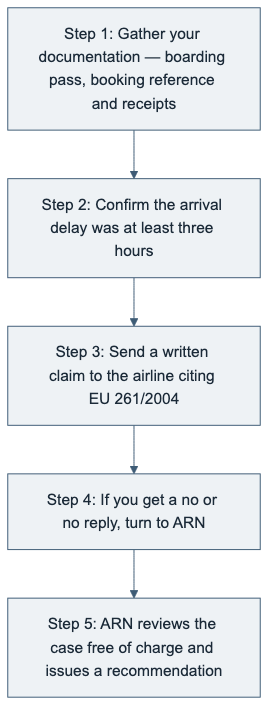
This page is about what you are entitled to. How you actually pursue it — the wording, where the claim is sent, how you escalate on a rejection — we have gathered on the page about claiming flight compensation yourself . The short version: the claim is free to file directly with the airline, and if the airline says no you can turn — free of charge — to ARN (Allmänna reklamationsnämnden, the Swedish National Board for Consumer Disputes). It is entirely possible to handle the whole process on your own.
If you would rather skip the paperwork, you can use a passenger-rights service. Such services — AirHelp is one of the larger ones — pursue the claim for you and take, in return, a commission on the amount, usually in the region of a quarter, if they succeed. If they win nothing, you pay nothing. It is purely a question of convenience: you trade part of the compensation for someone else handling the case. We go through what applies for a cancelled flight in a section of its own.
If you want to hand over your case, you can <a href="/go/airhelp" rel="nofollow sponsored noopener">start a free check with AirHelp</a>. This is an affiliate link — if your claim goes through, we may receive a fee, without affecting your commission. How it works we explain openly on the page about our affiliate disclosure . If you would rather do everything yourself, that route is free — start by claiming compensation on your own .
If your case is not a delay but a cancelled or overbooked flight, read instead cancelled flight compensation or denied boarding compensation . A broader picture of your rights is in the overview of EU 261 air passenger rights .
This is not legal advice
This page draws on published and institutional sources — expert review has not yet been carried out. For advice on your individual case, contact ARN (Allmänna reklamationsnämnden, the Swedish National Board for Consumer Disputes) or Transportstyrelsen (the Swedish Transport Agency), the supervisory authority for air passenger rights in Sweden.
Frequently asked questions
How does compensation for delayed flights actually work?
EU 261 gives a fixed flat-rate sum — €250, €400 or €600 — when you arrive at least 3 hours late at the final destination and the cause lay within the airline's control. The amount depends on the length of the flight, not on what the ticket cost. The compensation is not paid out automatically; you must claim it from the airline. Read more in missed connection compensation .
From documentation and a written claim to a free examination at ARN.
How many hours of delay are needed for compensation?
At least three hours, measured at arrival at your final destination. What counts is the difference between scheduled and actual arrival time — not how late the aircraft took off. If you arrived two hours and fifty minutes late, there is no right to the fixed compensation.
What is the difference between compensation and a refund for a delay?
Compensation is a fixed sum of €250–600 for the inconvenience of the delay. A refund is getting the ticket price back. With a delay you usually still travel, so a refund is rarely relevant — but if the delay has passed five hours you have the right to give up the trip and get the ticket refunded instead. Read more in denied boarding compensation .
Do I get compensation if the delay was caused by the weather?
Normally not. Extreme weather counts as an extraordinary circumstance beyond the airline's control, and the fixed compensation then falls away. The duty of care — food, drink and a hotel where needed — does apply even for a weather delay. If the delay was instead down to a technical fault or a missing crew, that is the airline's responsibility and compensation can be due.
How long after the delay can I claim compensation?
In Sweden the limitation period is ten years, which means you can claim compensation for a flight delay up to ten years back. It is still wise to claim the compensation as soon as possible, while documentation and boarding passes still exist.
Does it matter if I flew a low-cost airline like Ryanair or Wizz Air?
No. EU 261 applies equally to all airlines covered by the rules — low-cost carriers, network airlines and charter. The size of the compensation depends on the flight distance, not on the ticket price. A delayed ticket that cost SEK 400 can give €400 in compensation on the same terms as an expensive ticket.
Sources and further reading
- EUR-Lex — Regulation (EC) No 261/2004
- EU Court of Justice — Sturgeon and Others, joined Cases C-402/07 and C-432/07 (the 3-hour rule, delay measured at arrival)
- Transportstyrelsen — Air passenger rights (the supervisory authority in Sweden)
- Konsumentverket — Delayed and cancelled flights (the Swedish Consumer Agency)
- ARN — Allmänna reklamationsnämnden (the Swedish National Board for Consumer Disputes — resolves disputes free of charge for the consumer)
Last reviewed: 17 May 2026.


No comments yet