
EU 261 is the EU air passenger rights regulation — officially Regulation (EC) No 261/2004. It gives you the right to a fixed payment of €250, €400 or €600 (roughly SEK 2,800, 4,500 or 6,800) if a flight arrives more than three hours late, is cancelled at short notice, or if you are denied boarding because the airline overbooked. So the most common question on this subject — am I entitled to compensation? — has a fairly concrete answer: yes, if the disruption crosses one of those three thresholds and the airline cannot point to something outside its control. This page walks through the whole regulation in plain English: the amounts, the thresholds, who is covered and where the limits are.
The same regulation goes by many names, and that creates needless confusion. You will see it as EU261, EC261, EU Regulation 261/2004 and Regulation 261/2004. It is all the same thing. The correct name is Regulation (EC) No 261/2004 — the rest are everyday shorthand, and you do not need to worry about which version an airline or a forum thread happens to use.
Compensation is not a refund
Before anything else: two words that sound alike but mean separate things, and that airlines sometimes blur to their own advantage.
Compensation is a fixed flat amount of €250 to €600 that you receive for the inconvenience of a disrupted trip. The amount depends on the distance flown, not on what the ticket cost. A cheap ticket on a long route can pay €600; an expensive ticket on a short route pays €250.
A refund is something else entirely: it is getting the ticket money back when you choose not to travel at all.
They are two separate rights. With a cancelled flight you can be entitled to both at once: the ticket price back and compensation for the inconvenience. It is worth keeping the two apart, because an airline that offers you a refund will happily make it sound as if the matter is now closed. It is not. Accepting a refund does not automatically extinguish the right to compensation — but be careful what you sign, because wording about "full and final settlement" can do exactly that.
Compensation and a refund are two separate rights — with a cancelled flight you can be entitled to both.

The amounts and the 3-hour rule
EU 261 rests on two numbers that passengers anchor on: the threshold of three hours and the amounts €250 / €400 / €600. Here is how they fit together.
Compensation is triggered in three situations: a long delay, a cancelled flight, or denied boarding. For a delay, the flight has to have arrived at the final destination three hours or more after the scheduled arrival time. It is the arrival that counts — a flight that takes off late but makes up the time in the air and lands on schedule pays nothing.
The amount is set by the distance flown, measured as the crow flies between the first departure airport and the final destination:
| Distance | Compensation | Roughly in SEK | Delay required |
|---|---|---|---|
| Up to 1,500 km | €250 | ≈ SEK 2,800 | 3 hours |
| 1,500–3,500 km (always €400 within the EU) | €400 | ≈ SEK 4,500 | 3 hours |
| Over 3,500 km | €600 | ≈ SEK 6,800 | 4 hours* |
* On the longest routes (over 3,500 km, between the EU and a non-EU country) the airline may in some cases halve the compensation if the delay is between three and four hours — that brings it to €300 instead of €600. At four hours of delay or more, the full amount is due.
EUR is the legal unit in the regulation. The krona figures above are approximate and move with the exchange rate — flight-help services sometimes quote the range as SEK 3,000–7,200, which is the same thing at a different rate. Count in euros when you want to know exactly what you are entitled to; use the krona figures as a rough guide.
The three-hour threshold was not set in the original text of the law but by the Court of Justice of the EU, in the joined Sturgeon cases (C-402/07 and C-432/07). The Court decided that a long delay should be treated as equivalent to a cancelled flight when it comes to the right to compensation. If you want to run the numbers on your own case, work out what you may be owed from your route and the length of the delay.
The three situations: delay, cancellation, denied boarding
Delayed flight. A three-hour delay on arrival gives the right to compensation according to the table above. Under three hours, no compensation is due — but the duty of care can still apply. There is more on that on the page about compensation for a delayed flight.
Cancelled flight. Here the right depends on how early you were told. If the flight is cancelled with at least 14 days notice, normally no compensation is due. Between 14 and 7 days, or less than 7 days, compensation can be due — depending on how the rerouting the airline offers sits in time against your original trip. You always have the right to choose between rerouting and getting the ticket price back. The detail is on the page about compensation for a cancelled flight.
Denied boarding. If the airline overbooked and you are denied a seat against your will, you have the right to compensation at the same amounts as above — and here there is no three-hour threshold to cross first. If the airline instead asks for volunteers who give up their seat in return for compensation, and you put yourself forward, that is an agreement and not denied boarding in the meaning of the regulation.
Who is covered — and where
Geography is the point where most people read it wrong. EU 261 applies to:
- Every flight departing from an airport inside the EU — regardless of which airline operates it. An SAS flight, a Ryanair flight and an Emirates flight out of Stockholm Arlanda are all covered the same way.
- Flights arriving into the EU from a country outside the union — but only if they are operated by an EU-based airline.
A concrete example: a flight from Stockholm to New York is always covered, because it departs inside the EU. A flight from New York to Stockholm is covered if it is operated by, say, SAS or Lufthansa , but not if it is operated by a US carrier. The regulation also applies to Iceland, Norway and Switzerland, which apply the same rules.
It makes no difference where you live or where the ticket was bought. What decides it is where the flight departs and which airline operates it.
When the airline does not have to pay: extraordinary circumstances
An airline does not have to pay compensation if the disruption was caused by extraordinary circumstances — events outside its control that it could not have avoided even with all reasonable measures. The term is vaguely worded in the law, and airlines stretch it. It is worth knowing what it actually covers. Read more in extraordinary circumstances on flights .
Normally counts as extraordinary: extreme weather, strikes by air traffic control or airport staff, security threats, political instability and decisions by air traffic management that hit a single flight.
Normally does not count as extraordinary: most technical faults on the aircraft, because maintenance is part of an airline's ordinary business. Nor a strike by the airline's own staff — cabin crew or pilots — which as a rule does not count as outside the airline's control, meaning such a strike is usually grounds for compensation. That is a distinction many people get backwards, and we go through it more closely on the page about compensation for a flight strike and in the breakdown of extraordinary circumstances.
The burden of proof lies with the airline. It is not for you to show that the circumstance was not extraordinary — it is for the airline to show that it was. A short, general reference to "an event outside our control" in a standard email is not proof. Ask for a concrete explanation of what actually happened.
The compensation amount is set by the distance flown — €250, €400 or €600 measured as the crow flies.

The duty of care applies even without compensation
One thing never disappears, whatever the cause: the duty of care. Even when the compensation falls away because the disruption was extraordinary, the airline still has a duty to look after you while you wait. That means meals and drinks in reasonable quantity, the means to make a call or send an email, and — if there is an overnight wait — a hotel and transport to and from it.
This is a right separate from the cash compensation, and it applies to every longer disruption — a delay, a cancellation or denied boarding. If you buy your own meals or book a hotel when the airline does not arrange it, keep all your receipts. You have the right to be reimbursed for reasonable costs afterwards. There is more on what you can claim on the page about your right to meals and a hotel during a flight delay.
One important warning here: if you accept a refund of the ticket, the airline's duty of care ends at that same moment. If you choose to take the money back and arrange the trip yourself, you also cover meals and a hotel yourself. That is a reason not to rush to the refund button if you still need to get where you are going.
How long do you have to make a claim?
A question that often comes too late: how old can a claim be? EU 261/2004 sets no time limit of its own for how long after the disruption you can ask for compensation. Instead it is decided by the general limitation period in each country. In Sweden, the limitation period applied to this type of claim is ten years.
In practice that means you have plenty of time — a claim about a flight one or two years ago is not automatically lost. But do not wait without reason. The longer time passes, the harder it gets to produce the evidence: boarding passes go missing, emails are deleted, and the airline's own records of why a flight was delayed become harder to obtain. File the claim while you still have the paperwork in order.
How a claim works
The path to compensation under EU 261 is straightforward at its core, even if airlines like to make it look complicated.
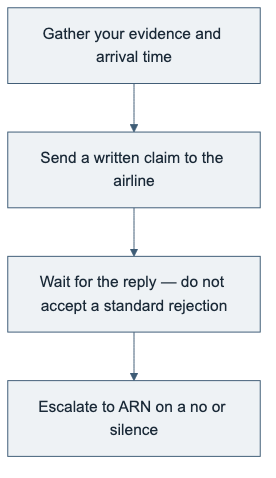
- Gather your evidence. Boarding pass or booking confirmation, flight number and date, and everything in writing you received from the airline — texts, emails, information at the gate. Note the actual arrival time as precisely as you can.
- Contact the airline directly. Send a clear, concise claim to the airline — not to the travel agency you booked through. State what happened, what compensation you are asking for and to which account.
- Wait for the reply — and do not let yourself be brushed off. A no in the first reply is common and does not mean the matter is settled. A standard email about "an event outside our control" with no concrete explanation is not an acceptable rejection.
- Escalate on a no. If you get a no or no reply, you can turn to ARN (Allmänna reklamationsnämnden — the Swedish National Board for Consumer Disputes), which examines the dispute at no cost. Transportstyrelsen (the Swedish Transport Agency) is the supervisory authority and receives complaints.
You can run all of this yourself without paying anyone — that is the free official route, and for many cases it is plenty. There is a detailed step-by-step walkthrough on the page about claiming flight compensation yourself. If you find the process too much of a burden, there are flight-help services that pursue the claim for a share of the compensation; we go through the pros and cons of that separately. The point here is that the choice is yours, and that you do not have to pay anyone to get what the regulation gives you.
EU 261/2004 and the new rules for 2026
There are two sets of rules in circulation, and they should not be mixed up.
EU 261/2004 — this page — is the regulation that applies today and that governs every flight disrupted now.
Regulation (EU) 2026/261 is the revised successor. It is published in EUR-Lex, but its substantive rules take effect after a transition period. The reform does not change the compensation amounts of €250/€400/€600, but it rewrites several definitions and tightens the claim process. Which set of rules governs a claim is decided by the date of the disruption itself — not by when the claim is filed.
One more thing, because it confuses many people: the 2026 air-travel reform is not the same as the EU's new rules for rail passenger rights. If you search for "new passenger rights directive" you can land in the rail rules instead. If you want to know what the air reform means, read our breakdown of EU 261's new rules for 2026.
An EU 261 claim in four steps: gather your evidence, contact the airline, wait for the reply, escalate on a no.

This is not legal advice
This page is based on published and institutional sources — expert review is still pending. For advice on your individual case, turn to ARN (the Swedish National Board for Consumer Disputes) or Transportstyrelsen (the Swedish Transport Agency), which is the supervisory authority for air passenger rights in Sweden. Both examine cases at no cost to you as a consumer.
We date and update this page when EUR-Lex, Transportstyrelsen, Konsumentverket (the Swedish Consumer Agency) or the Court of Justice of the EU brings out something that changes the picture.
Frequently asked questions
Am I entitled to compensation under EU 261?
You are entitled to compensation if the flight arrived more than three hours late, was cancelled with less than 14 days notice, or if you were denied boarding because of overbooking — and if the trip departed from an EU airport or was flown into the EU by an EU-based airline. The compensation is €250, €400 or €600 depending on the distance. It falls away only if the airline can show that the disruption was caused by an extraordinary circumstance.
What is the difference between compensation and a refund?
Compensation is a fixed flat amount — €250 to €600 — for the inconvenience of a disrupted trip. A refund is getting the ticket price back when you choose not to travel. They are two separate rights. With a cancelled flight you can be entitled to both at once: the ticket money back and compensation for the inconvenience. Read more in compensation for a flight strike .
The four steps of an EU 261 claim — from evidence to escalation at ARN.
How long a delay do you need to get compensation under EU 261?
Three hours. If you arrive at your final destination three hours or more after the scheduled arrival time, that is treated as equivalent to a cancelled flight for the purpose of compensation. The rule was settled by the Court of Justice of the EU in the joined Sturgeon cases (C-402/07 and C-432/07). It is the arrival time that counts, not the departure time.
Does EU 261 also apply to flights outside Europe?
The regulation covers every flight departing from an airport inside the EU regardless of the airline, plus flights arriving into the EU if they are operated by an EU-based airline. A flight from Stockholm to New York is covered. A flight from New York to Stockholm is covered if it is operated by an EU airline, but not if it is operated by a non-European one.
What applies if the flight was cancelled because of weather or a strike?
Then it comes down to extraordinary circumstances. Extreme weather and strikes by air traffic control or airport staff are normally treated as circumstances outside the airline's control, and the cash compensation falls away. A strike by the airline's own staff, on the other hand, is usually grounds for compensation. The duty of care — meals, drinks and a hotel if needed — applies regardless, even when the compensation falls away.
Is EU 261 the same thing as the new rules for 2026?
No. EU 261/2004 is the regulation that applies today. Regulation (EU) 2026/261 is the revised successor, published in EUR-Lex but with substantive rules taking effect after a transition period. Which set of rules governs your claim is decided by the date of the disruption. For a flight disrupted now, 261/2004 still applies. Read more in the reform of passenger rights .
Sources and further reading
- EUR-Lex — Regulation (EC) No 261/2004 and Regulation (EU) 2026/261
- Court of Justice of the EU — Sturgeon and Others, joined cases C-402/07 and C-432/07 (the 3-hour rule)
- Transportstyrelsen — Passenger rights (supervisory authority in Sweden)
- Konsumentverket — cancelled and delayed flights (the Swedish Consumer Agency)
- ARN — Allmänna reklamationsnämnden — examines consumer disputes at no cost
If you want to see how a claim is run in practice, see the page about claiming flight compensation yourself. If you are wondering what the 2026 reform changes, start with EU 261's new rules for 2026.


No comments yet