
Regulation 2026/261 — the reform of the EU air passenger rights regulation — does not change the compensation amounts. €250, €400 and €600 (roughly SEK 2,800, 4,500 and 6,800) stay as they are. What the reform touches is how a claim is handled: clearer response deadlines for airlines and stronger duties to handle a claim correctly. The free official route via ARN (Allmänna reklamationsnämnden — the Swedish National Board for Consumer Disputes) and Transportstyrelsen (the Swedish Transport Agency) remains in place. This page walks through what changes in the claim process, what is still uncertain, and how you pursue a claim in practice. Kravflyg explains, step by step, what to do in this situation.
The problem the reform is going after
The most common complaint under EU 261/2004 is not about the rules themselves but about how airlines apply them. The pattern is familiar to anyone who has pursued a claim: a "no" in the first reply, then silence, then an offer lower than what the regulation sets out — and a process that can drag on for months. Passengers describe airlines that announce they "can reduce the compensation by 50%", and standard emails that point to "an event outside our control" without explaining what actually happened.
That is what the reform is going after. Not the amounts — but airlines' incentive to stall and dismiss.
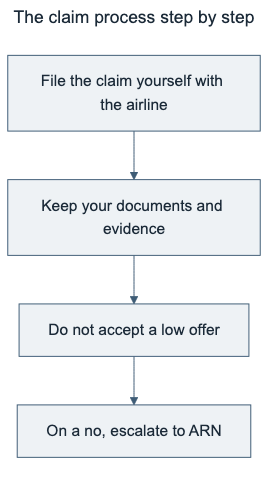
The claim process in four steps — from your own claim to escalation at ARN.
What the reform tightens
Regulation 2026/ 261 aims to tighten the requirements on how airlines handle compensation claims. Two areas are in focus.
Response deadlines. Under 261/2004 there are few explicit time limits for how quickly an airline must respond to and process a claim. The reform wants to introduce clearer deadlines. The exact shape — how many days, and what happens if a deadline is missed — depends on the final consolidated text in EUR-Lex, and we will not state it as settled until it is.
More active handling. The reform discusses stronger duties for airlines to inform passengers about their rights and to handle compensation more proactively. How far such a duty reaches in the final text is not yet clear-cut.
The table summarises the difference:
| Element | EU 261/2004 (applies now) | Regulation 2026/261 (after transition) |
|---|---|---|
| Response deadline on the airline | Few explicit time limits | Clearer deadlines — exact level depends on final text |
| Information to the passenger | Duty to inform, applied unevenly | Stricter requirements on information and handling |
| Official review route | ARN and Transportstyrelsen, free of charge | Remains |
| Duty of care during the wait | Meals, drinks, hotel during a longer disruption | Remains; clarified |
No row is a weakening. The reform shifts the burden a little towards the passenger — but exactly how far is decided by the final text.
What does not change: the free route
One thing is worth stating plainly, because talk of reform sometimes makes people think everything becomes new: the free official route remains. If the airline says no, you can still turn to ARN, which reviews consumer disputes at no cost to you. Transportstyrelsen remains the supervisory authority for air passenger rights in Sweden. The reform aims to strengthen the process — not to remove the free routes that already exist. Read more in EU 261’s new rules for 2026 .
The duty of care also remains. The airline’s obligation to provide meals, drinks and, if needed, a hotel during a longer disruption applies under the reform just as it does today, and it applies even when the cash compensation falls away because the disruption was extraordinary. One thing to keep in mind: if you accept a refund of the ticket, the duty of care ends at that same moment.
How to pursue a claim — whatever the rules
Until the reform’s rules come into force and the deadlines are settled, the practical advice is the same as under 261/2004:
- File the claim yourself. Do not wait for the airline to get in touch — assume you are the one applying. Write to the airline with the flight number, date, route and a short description of the disruption.
- Keep your evidence. Boarding pass, texts and emails from the airline, a photo of the arrivals board, receipts for meals and a hotel. The evidence is what decides the case.
- Do not accept a low offer on reflex. An offer below the regulation’s amount, or a voucher instead of money, is not something you have to agree to.
- If the answer is no — escalate to ARN. It costs you nothing and is the natural next step when the airline says no or drags its feet.
A detailed walkthrough of each step is on the page about claiming flight compensation yourself. The reform shifts the emphasis — it puts more responsibility on the airline — but the basic move for you as a passenger is the same.
Three stalling tactics to recognise
The reform’s response deadlines are there to tighten up exactly the patterns passengers have run into for years. Recognising them helps already today, under EU 261/2004.
The silent rejection. The airline does not reply at all, or replies with an acknowledgement and then nothing. Silence is not a legal rejection — it is a reason to escalate. Set your own time limit in your first email, four weeks for example, and move on to ARN if it passes without a concrete answer.
The disguised cost excuse. "An event outside our control" with no description of what actually happened is not a valid basis. Ask for a concrete explanation. Was it a technical fault, a weather situation, a strike — and whose? An airline that cannot pin that down will struggle to stand on an extraordinary circumstance.
The low offer. An offer below the regulation’s amount, or a voucher instead of money, is a bid — not a verdict. You can decline it and hold out for the full amount. Do not sign anything about "full and final settlement" if the offer is lower than what you are entitled to.
The reform’s stricter handling requirements are meant to reduce the room for all three. But even before those rules apply, the counter-move is the same: document, set your own time limits, and escalate to ARN without waiting longer than necessary.
How this page fits with the rest
The claim process is one of three parts of the 2026 reform. The other two have their own pages: the new delay thresholds and the new definitions. For the full picture, see the walkthrough of EU 261’s new rules for 2026.
This is not legal advice
This page is based on published and institutional sources — an expert review has not yet been carried out. The rules around the 2026 reform are in transition, and the response deadlines may be adjusted in the final texts. For advice on your individual case, turn to ARN (the Swedish National Board for Consumer Disputes) or Transportstyrelsen (the Swedish Transport Agency), the supervisory authority for air passenger rights in Sweden.
Frequently asked questions
How does the claim process change under EU 261 in 2026?
The reform does not change the compensation amounts — it changes how a claim is handled. Regulation 2026/261 aims to set clearer response deadlines for airlines and stronger duties to handle claims correctly. The exact shape of those deadlines depends on the final text in EUR-Lex and should not be stated as settled yet.
Does the airline have to pay compensation without me applying?
The reform discusses stronger duties for airlines to inform passengers about compensation and to handle it more actively. How far such a duty reaches in the final text is not yet clear-cut. Until it is, you should assume that you file the claim yourself — do not wait for the airline to get in touch.
Which claim process applies if my flight is disrupted now?
EU 261/2004 and today’s process: you contact the airline first, and if it says no you can turn to ARN (the Swedish National Board for Consumer Disputes). Transportstyrelsen is the supervisory authority. That route is free for you as a consumer and is not affected by the reform for a disruption that happens today. Read more in the new delay thresholds for 2026 .
Do ARN and Transportstyrelsen disappear as a route under the 2026 rules?
No. The free official route remains. You can still bring a dispute to ARN at no cost, and Transportstyrelsen remains the supervisory authority for air passenger rights in Sweden. The reform aims to strengthen the process, not to remove the free review routes.
Does the duty of care change under the 2026 rules?
The duty of care — the airline’s obligation to provide meals, drinks and, if needed, a hotel during a longer disruption — remains in the reform and is clarified. It applies even when the cash compensation falls away because of an extraordinary circumstance. If you accept a refund of the ticket, however, the duty of care ends.
Sources and further reading
- EUR-Lex — Regulation (EU) 2026/261 and Regulation (EC) No 261/2004
- Transportstyrelsen — Passenger rights (the supervisory authority in Sweden)
- Konsumentverket (the Swedish Consumer Agency) — Cancelled and delayed flights
- ARN — Allmänna reklamationsnämnden (the Swedish National Board for Consumer Disputes) — reviews consumer disputes at no cost


No comments yet