
"Am I entitled to compensation?" is the most common question around delayed and cancelled flights — and the answer hinges on four concrete things. This page is not an essay on EU 261. It is a check: answer four questions about your trip, and you will see straight away whether you are likely entitled to the fixed compensation of €250 to €600 (roughly SEK 2,800 to 6,800), and where to go next for your particular case. Kravflyg sets out air passenger rights in plain language.
One thing before we begin. Compensation is a fixed flat-rate sum for the inconvenience. A refund is getting the ticket price back. These are two separate rights — this page is about the compensation. The mix-up is common, so keep them apart.
The four questions
You are normally entitled to EU 261 compensation if the answer is yes to all four:
- Did the flight depart from an EU airport — or land in the EU with an EU-based airline?
- Did you arrive at least 3 hours late, was the flight cancelled, or were you denied boarding?
- Did the cause lie within the airline's control?
- If the flight was cancelled — did you get the notice less than 14 days before departure?
If one of the answers turns out to be no, the right to compensation is usually gone — but not always every right. We go through the questions one at a time.
Four questions that show where your case belongs — and whether you can get compensation.
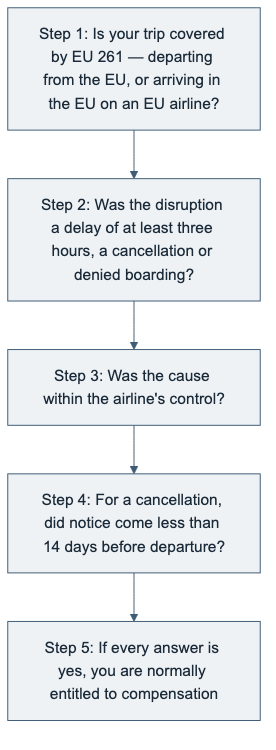
Question 1 — Is your trip covered by EU 261?
EU 261 applies if either:
- your flight departed from an airport within the EU (plus Norway, Iceland and Switzerland) — whatever airline it was, or
- your flight landed at an airport within the EU and was operated by an airline based in the EU.
A flight Stockholm–New York is always covered, because it departed in the EU. A flight New York–Stockholm is covered if it was flown by, for example, SAS or Lufthansa , but not if it was flown by a purely American carrier. If the answer is no, EU 261 is not your route — then another country's rules or the airline's own terms may apply instead.
Question 2 — Was the disruption large enough?
Three situations can give a right to compensation:
- Delay. You arrived at least three hours late at your final destination.
- Cancelled flight. The departure did not take place at all.
- Denied boarding. You were refused a seat despite a valid booking, usually because of overbooking.
This is where many go wrong: the 3-hour rule is measured at arrival, not at departure. What counts is how late you stepped off the aircraft at the final destination. The EU Court of Justice settled this in the Sturgeon case (C-402/07). An aircraft can take off four hours late and still make up time in the air — if you arrived under three hours late there is no compensation, however frustrating the wait at the airport felt.
If your case is a cancelled flight, read on at cancelled flight compensation . If it is a delay, see flight delay and compensation .
Question 3 — What was the cause?
This is often the question that tips the balance. The airline avoids paying the fixed compensation if the disruption was caused by extraordinary circumstances — something beyond its control that it could not have prevented. We go through what applies when weather delays a flight in a section of its own.
Roughly divided:
| Cause | Within the airline's control? | Compensation normally? |
|---|---|---|
| Technical fault on the aircraft | Yes | Yes |
| Crew missing / arrives late | Yes | Yes |
| The airline's own staff strike | Yes | Yes |
| Extreme weather | No | No |
| Air-traffic-control strike (ATC) / safety decision | No | No |
| Bird strike | No | No |
Every cause has its nuances. Dig deeper through the spoke that fits your case:
- Technical fault — usually the airline's responsibility.
- Weather — normally extraordinary, but not always.
- Bird strike — counts as extraordinary.
- ATC and safety reasons — normally no compensation.
- Strike and extraordinary circumstances — the airline's own staff versus an outside strike.
- Extraordinary circumstances — the full picture.
And whatever the cause: the duty of care — food, drink and, where needed, a hotel — always applies. It never falls away, not even in extreme weather.
Question 4 — When did you get the notice of a cancelled flight?
This question applies only to cancelled flights. If the airline announces the cancellation at least 14 days before the scheduled departure, the fixed compensation falls away. You still have the right to choose between getting the ticket price back and being rerouted — but no cash compensation.
If the notice comes later than 14 days before departure, compensation can be due, and the amount depends on how the rerouting offered affected your departure and arrival times. If the airline handles the rerouting so that you arrive roughly on time, the compensation can be reduced or fall away.
Tricky cases that do not fit the template
Some situations need their own assessment:
- Only one leg was delayed. If you booked the whole trip on one ticket, the delay is counted at the final destination — if you arrived at least three hours late the claim is assessed on the whole journey, even if only one connection broke. If you booked the legs separately with different airlines, your position is weaker. See missed connection compensation .
- Cancelled more than 14 days in advance. No fixed compensation, but you choose freely between a refund and rerouting.
- Standby ticket. A standby seat or a staff ticket not sold to the public normally gives no right to compensation — EU 261 requires a confirmed booking.
- You accepted rerouting on the spot. You keep your right to compensation if the delay still ended up at least three hours — but never sign a paper waiving your rights without reading it.
Work out the amount — and the next step
Are your four answers leaning the right way? Then it remains to see how much. The amount depends on the length of the flight: €250, €400 or €600. Use our guide to work out flight compensation to see which level your trip lands at.
This is not legal advice
This page draws on published and institutional sources — expert review has not yet been carried out. For advice on your individual case, contact ARN (Allmänna reklamationsnämnden, the Swedish National Board for Consumer Disputes) or Transportstyrelsen (the Swedish Transport Agency), the supervisory authority for air passenger rights in Sweden.
Frequently asked questions
Can I claim compensation if only one of my flights was delayed?
What matters is how late you were at the final destination, not at a stopover. If you booked the whole trip on one ticket and arrived at least 3 hours late because of a missed connection, the claim is assessed on the whole journey. If you booked the legs separately with different airlines, your position is weaker.
Am I entitled to compensation if the flight was cancelled more than 14 days in advance?
No. If the airline announces a cancellation at least 14 days before the scheduled departure, the fixed compensation falls away. You still have the right to choose between a refund of the ticket and rerouting. If the notice came later than 14 days before departure, compensation can be due, depending on how the rerouting affected your times.
Is the 3-hour rule counted at departure or at arrival?
At arrival. What counts is how late you reached your final destination, not how late the aircraft took off. The EU Court of Justice settled this in the Sturgeon case (C-402/07). An aircraft can take off four hours late but still arrive under three hours late — and then no compensation is triggered.
Can I claim compensation on a standby ticket?
Normally not. EU 261 requires a confirmed booking on the flight in question. A standby ticket or a heavily discounted staff ticket not available to the public does not, as a rule, give a right to the fixed compensation.
Does it matter why the flight was delayed?
Yes, the cause is often what decides it. Technical faults and a crew that is not enough lie within the airline's control and normally give a right to compensation. Extreme weather, an air-traffic-control strike and safety decisions count as extraordinary circumstances and normally give no compensation — but the duty of care always applies. Read more in our overview of where the line falls on extraordinary circumstances .
Sources and further reading
- EUR-Lex — Regulation (EC) No 261/2004
- EU Court of Justice — Sturgeon and Others, joined Cases C-402/07 and C-432/07 (the 3-hour rule, delay measured at arrival)
- Transportstyrelsen — Air passenger rights (the supervisory authority in Sweden)
- Konsumentverket — Delayed and cancelled flights (the Swedish Consumer Agency)
- ARN — Allmänna reklamationsnämnden (the Swedish National Board for Consumer Disputes — resolves disputes free of charge for the consumer)
Last reviewed: 17 May 2026.


No comments yet